

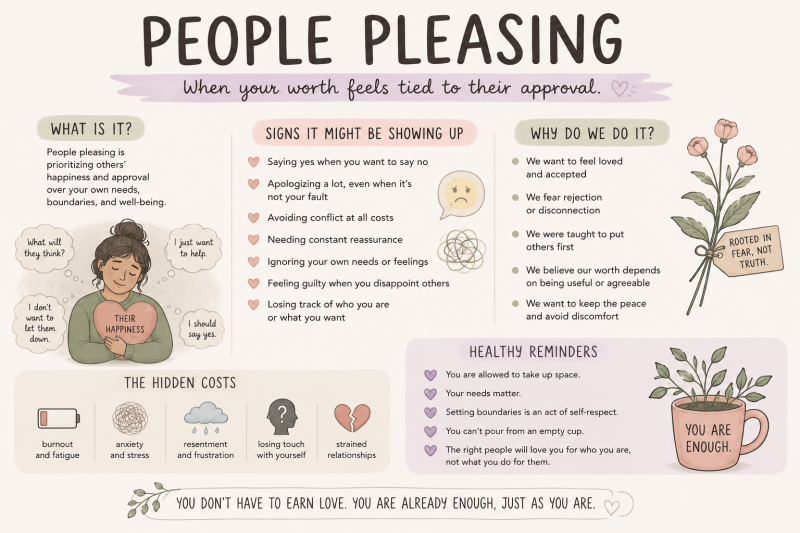
The Cost of Keeping the Peace
We have all been conditioned to believe that being the "nice one" is the ultimate social gold standard. We want to be liked, we want to be helpful, and we certainly don’t want to cause a scene. But there is a point where being accommodating stops being a virtue and starts becoming a slow-motion erasure of who you actually are. I know this dynamic intimately.
As a therapist, I am inclined to accommodate flexibility in fitting people into my busy schedule. I asked my scheduling staff to talk with me if they needed to fit someone in during my sacred times such as lunch or at the end of my day. The first few times, my staff asked if I had plans… and then I started to notice they stopped asking and just scheduled whatever worked for them, leading to an overload for me as a clinician. I was people-pleasing - my staff, my boss, and my clients.
There is a tipping point where genuine kindness crosses the line into chronic people-pleasing – a subtle but dangerous shift. Genuine kindness is a conscious choice made from a place of abundance, security, and mutual respect. People-pleasing, on the other hand, is a survival strategy driven by anxiety. It is the chronic habit of prioritizing other people’s needs, desires, and comfort over your own, often out of a deep-seated fear of conflict, criticism, or rejection.
If you frequently find yourself exhausted, resentful, or entirely unsure of what you actually want out of life, you aren't just being nice—you might be caught in a people-pleasing trap. Here is a look at where this behavior comes from, and how to start unlearning it.
Where Does People-Pleasing Come From?
No one is born a people-pleaser. It is a learned behavior, often developed early in life as a survival strategy to navigate unpredictable, chaotic, or emotionally demanding environments.
- The Trauma Response - For some, the safest way to de-escalate a threat or survive a volatile environment (such as growing up with an unpredictable or highly critical caregiver) is to aggressively accommodate the threatening person. Over time, "keeping the peace" becomes a hardwired instinct.
- Conditional Love and Praise - Many people-pleasers grew up in environments where love, attention, or validation felt conditional. If you were praised primarily for being "the easy child," "so helpful," or for never causing trouble, you may have internalized a dangerous equation: My worth is entirely dependent on how useful I am to others.
- Fear of Abandonment - At its core, people-pleasing is an attempt to control how others perceive us. The subconscious logic is: If I am perfectly accommodating, you will never have a reason to leave me or be angry with me. It is a preemptive strike against rejection.
How People-Pleasing Erases Intimacy
The ultimate irony of people-pleasing in romantic relationships is that it destroys the very closeness it is trying to protect. We accommodate, stay quiet, and anticipate our partner's every need because we want to guarantee love and security. But true intimacy requires two whole, visible people. When one partner hides their true self to keep the peace, the relationship suffers in a few distinct ways.
You Become a Moving Target - you. They are relating to a curated version of you designed to keep them happy. This creates an invisible wall. Your partner may feel a sense of superficiality or disconnect, sensing that you aren't fully showing up as a genuine, authentic counterpart.
The Resentment Time-Bomb - No one can suppress their own needs forever. When you consistently say "yes" to things you secretly resent, that unexpressed frustration doesn’t just disappear—it pools under the surface. Eventually, it leaks out as, passive-aggressive comments or subtle emotional withdrawal, sudden, explosive arguments over minor things (like an unwashed dish) that are actually about years of unmet needs, or physical or emotional checking out, as a subconscious way to protect yourself from further self-sacrifice.
The Exhausting Dynamics of Over-Functioning - People-pleasers often fall into the trap of over-functioning—taking on 100% of the emotional labor, planning, and problem-solving in the relationship to ensure their partner stays comfortable.
Ultimately, a healthy partnership requires the capacity to navigate tension. By avoiding all conflict, you miss out on the repair process—which is exactly how couples build deep, lasting trust.
The Workplace Chameleon: Courtesy vs. Self-Sabotage
In a professional environment, people-pleasing is highly rewarding in the short term, but deeply damaging in the long run. Because workplaces naturally praise "team players," workers who pull extra weight, and people who step up in a crisis, it can be incredibly difficult to spot when your professional courtesy has crossed over into self-sabotage. When you treat your boundaries as optional at work, you don't just burn out—you often stall your own career progression.
The "Caped Crusader" Trap (Over-Committing) - Workplace people-pleasers have a knee-jerk habit of taking on tasks that aren't theirs to solve. If a project falls behind, an email thread goes unanswered, or a colleague is struggling, they step in to rescue the situation. The professional cost: When you are constantly managing everyone else's low-level fires, you run out of the mental bandwidth needed to focus on your own high-impact, high-visibility goals. You become invaluable for your utility, but overlooked for leadership.
Agreeability Over Authority - True leadership and innovation require the willingness to push back, challenge bad ideas, and navigate healthy friction. A people-pleaser will often sit silently in a meeting, nod along with a flawed strategy, or say "Whatever the team thinks is best," purely to avoid a tense debate. The professional cost: By filtering out your unique perspective to keep the meeting frictionless, you inadvertently signal that you lack a distinct point of view. Agreeability is often misread as a lack of authority or vision.
The Boundary Matrix: Spotting the Shift - To protect your professional career, it helps to recognize how standard helpfulness differs from chronic people-pleasing. The professional cost:If you treat every request from a colleague or manager as an absolute command, you hand over control of your calendar, your career trajectory, and your mental health to anyone who happens to ask for your time.
How to Break the Cycle
Healing from people-pleasing doesn’t mean becoming cold, selfish, or unhelpful. It means learning to be authentic rather than purely accommodating. Here is how to start making the shift.
1. Institute the 24-Hour Rule
People-pleasers often say "yes" as a knee-jerk reflex to avoid the immediate discomfort of saying "no." Break this circuit by removing the pressure of the moment. Memorize a few stalling phrases such as "Let me check my schedule and get back to you." or "I need to think about my bandwidth; I'll let you know tomorrow/after lunch." This gives your nervous system time to settle so you can figure out if you actually have the time and energy to commit.
2. Start with "Micro-Boundaries"
You don't need to start your recovery by confronting your most intimidating relative or your boss. Start small. Practice setting boundaries where the stakes are incredibly low:
- Tell the barista your order is actually wrong.
- Leave a conversation that has dragged on too long.
- Decline a minor social invitation without giving an elaborate excuse.
3. Learn to Tolerate the Guilt
When you start setting boundaries, you will feel guilty. Expect this. Guilt is not a sign that you did something wrong; it is simply a symptom of breaking an old habit. When the guilt arises, acknowledge it, but don't act on it. Remind yourself that someone else’s disappointment is not a crisis you are required to solve.
4. Ditch the Over-Apologizing
Notice how often you say "I'm sorry" for things that don't require an apology (like taking up space, asking a question, or declining an invite). Practice replacing apologies with gratitude. Instead of saying, "I'm so sorry I'm late," try, "Thank you so much for your patience."
Finding Your Authentic "Yes"
Overcoming people-pleasing is a gradual process of reclaiming your identity. Every time you say a healthy "no" to someone else, you are saying "yes" to yourself. By learning to tolerate the temporary discomfort of setting boundaries, you make room for authentic connection, professional respect, and relationships built on mutual care rather than chronic self-sacrifice.